Beyond Transactional Faith: Integrating Grace, Works, and True Kingdom Prosperity
In discussions around Christian theology, two major perspectives often seem to be in conflict. On one side stands the foundational doctrine of justification by grace through faith: the conviction that human effort cannot earn salvation. On the other side is the “Prosperity Promise,” which emphasizes God’s desire to provide tangible health, wealth, and practical abundance to believers in this life.
When viewed superficially, these two approaches can appear irreconcilable. When prosperity theology frames faith as a transactional tool—where financial giving or ritualized works guarantee a temporal payout—it inadvertently resurrects the ancient error of works-based righteousness. However, when properly ordered according to Scripture, the message of unmerited grace and the vision of real-world stewardship can be harmonized into a balanced framework for Christian living.
1. The Flaw of Human Merit: Why Works Alone Fall Short
The primary baseline of biblical theology is that human effort cannot bridge the moral gap between a holy God and fallen humanity. Scripture consistently addresses the limitations of self-righteousness and legalistic performance:
- The Impurity of Human Merit: Prophetically described in Isaiah 64:6, even human “righteous acts” carry the taint of imperfect motives when measured against divine perfection.
- The Diagnostic Role of the Law: Paul clarifies in Romans 3:20 that the Law was given not as a vehicle for self-salvation, but as a diagnostic instrument. The Law acts as a mirror that reveals sin; it exposes the debt but lacks the power to cancel it.
- The Exclusive Means of Justification: Ephesians 2:8–9 explicitly positions salvation as an unearned gift: “For it is by grace you have been saved, through faith—and this is not from yourselves, it is the gift of God—not by works, so that no one can boast.”
Because salvation originates entirely in divine mercy (Titus 3:5), grace and works-based justification are mutually exclusive foundations. As Abraham demonstrated in Genesis 15:6, righteousness is credited through faith long before religious works or legalistic codes enter the picture.
2. The Pitfall of Transactional Prosperity
While grace secures the believer’s spiritual standing, human nature frequently attempts to re-introduce a transactional system. In its extreme forms, Prosperity Theology re-introduces “works” under the guise of “seed-faith” or spiritual formulas.
| Feature | Salvation by Grace through Faith | Transactional Prosperity Model |
| Core Goal | Spiritual reconciliation and eternal life with God. | Physical health, financial increase, and earthly ease. |
| Primary Problem | Sin and spiritual death (Romans 6:23). | Lack, sickness, and unrealized personal potential. |
| Role of Faith | Humbled trust in Christ’s finished work (Romans 5:1). | An operational key or force used to activate material laws. |
| Role of Works/Giving | Fruit of gratitude; evidence of transformation (James 2:17). | A financial deposit intended to leverage a guaranteed return. |
| Ultimate Orientation | God-Centered: Humankind exists for God’s glory. | Man-Centered: Divine power is directed toward human comfort. |
When giving or serving is used primarily to obligate God to return material wealth, faith devolves into a commercial exchange. God ceases to be the Lord to be worshipped and becomes a mechanism to be managed.
3. The Synthesis: Grace as the Root, Works as the Fruit, Prosperity as the Tool
To synthesize these concepts without compromising core doctrine, the relationship between grace, human activity, and practical resources must be properly sequenced:
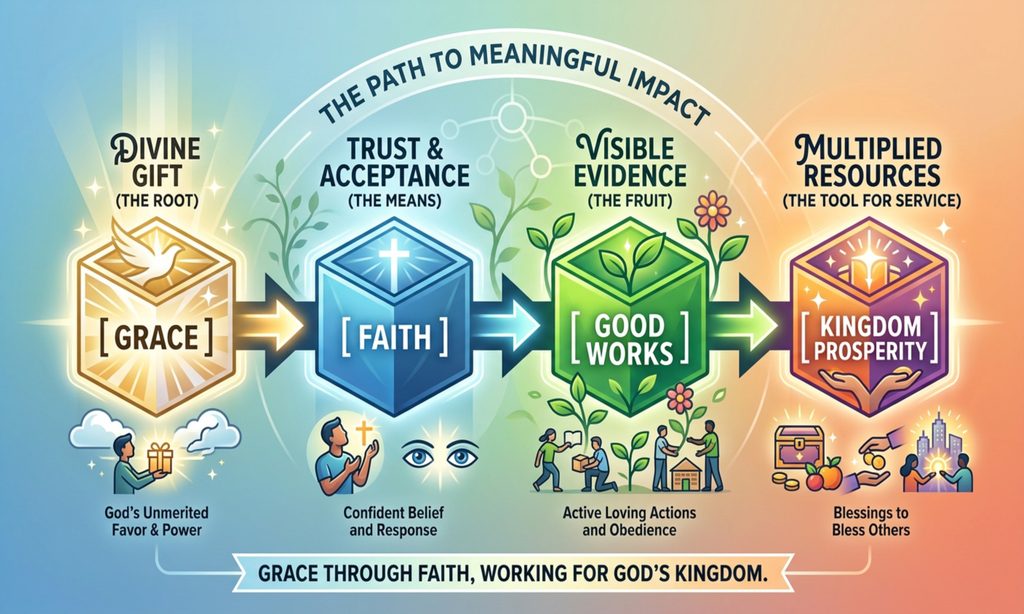
Step 1: Grace as the Absolute Root
Salvation from sin is received entirely as a gift through faith in Jesus Christ (Galatians 2:21). There is no financial seed, ritual performance, or moral effort that can buy peace with God. Grace eliminates human boasting and grounds the believer’s identity in what Christ has already finished.
Step 2: Good Works as the Necessary Fruit
While works cannot cause salvation, true faith inevitably produces them. As James 2:17 notes, faith without action is dead. Good works are the visible result of an inward transformation—the evidence of a life re-aligned with God’s character.
Step 3: Prosperity as Kingdom Resource
When stripped of self-indulgent motives, practical abundance takes on a holy purpose: Kingdom Stewardship. God does not enrich His people merely for personal luxury, but to increase their capacity to bless others and advance practical good.
This balanced model is anchored in 2 Corinthians 9:8:
“And God is able to bless you abundantly, so that in all things at all times, having all that you need, you will abound in every good work.”
Conclusion: A Life of Purposeful Stewardship
True biblical prosperity is not the cause of salvation, nor is it a reward earned through spiritual leverage. Rather, it is the provision God grants to believers so they can carry out meaningful, practical work in the world.
When grace is understood as the root, good works as the natural fruit, and material resources as the tools for service, the tension between faith and practical provision dissolves. The believer is freed from the anxiety of trying to earn God’s favor, empowered to live generously, and equipped to turn practical resources into real-world impact.