From the Accuser to the Inner Critic: Reinterpreting “The Enemy” and Salvation in Modern Thought
In traditional Christian teaching, the human experience is framed within a cosmic drama: a struggle against an external adversary known as “the Enemy,” “the Great Accuser,” or Satan. For centuries, this framework provided believers with a language to understand temptation, guilt, and the debilitating weight of shame.
As spiritual philosophy evolved through 19th- and 20th-century movements—such as New Thought, Unity, and Religious Science—and merged with modern psychology, these traditional concepts underwent a radical reinterpretation. Rather than viewing “the Enemy” as an external supernatural entity, modern metaphysical frameworks reframe this adversary as an internal state of consciousness.
Understanding this shift illuminates how both classical biblical theology and modern metaphysical thought seek to liberate humanity from shame and elevate the human spirit.
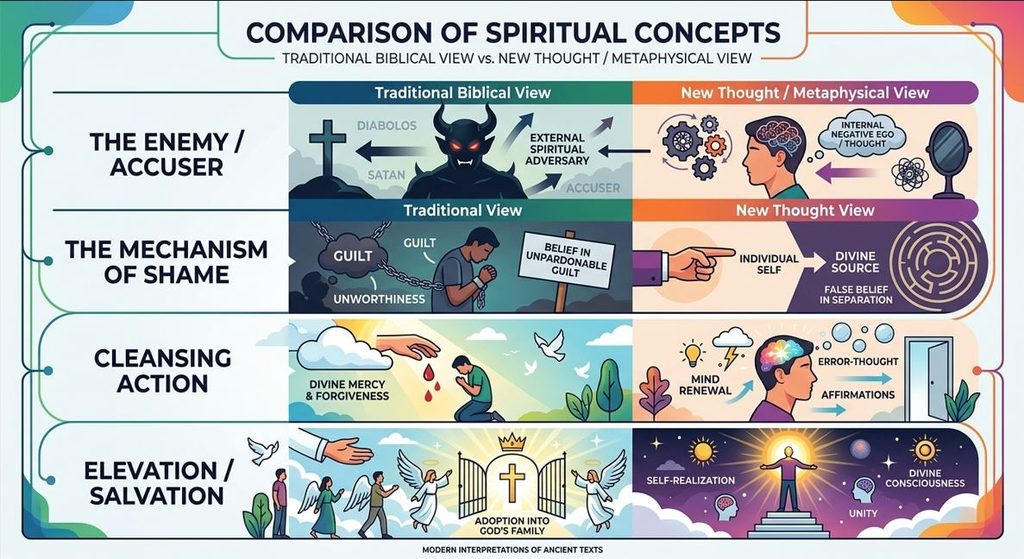
1. The Biblical Roots of “The Enemy” and “The Accuser”
In biblical texts, “the Enemy” is portrayed as an active, spiritual entity opposed to God and humanity. The Greek word diabolos literally translates to “slanderer” or “one who casts accusations,” while Satanas stems from Hebrew for “adversary.”
The Bible explicitly highlights this prosecutorial role in Revelation 12:10, describing Satan as “the accuser of our brothers and sisters, who accuses them before our God day and night.”
In texts like Job 1–2 and Zechariah 3:1–2, the Accuser acts like a prosecutor in a heavenly courtroom, pointing out human flaws and arguing that humanity is unrighteous. Scripture warns believers to remain alert against these spiritual forces, framing the struggle not against human opponents, but against cosmic powers of darkness (Ephesians 6:12).
2. Shame: The Weapon of the Enemy vs. Divine Conviction
In classic theology, the Great Accuser operates primarily through shame. A crucial distinction is made between divine conviction and demonic accusation:
| Dynamic | God’s Conviction (Holy Spirit) | The Enemy’s Accusation (Shame) |
| Focus | Behavior: “You made a mistake/sinned.” | Identity: “You ARE a mistake/fundamentally broken.” |
| Goal | Restoration, forgiveness, and transformation. | Isolation, self-hatred, hiding, and spiritual paralysis. |
| Direction | Draws a person toward God. | Drives a person away from God (like Adam hiding in the garden). |
| Ultimate Voice | “There is now no condemnation…” (Romans 8:1) | “You will never be good enough.” |
While conviction aims to heal and correct, shame attacks core identity, keeping individuals trapped in fear and self-condemnation.
3. The Modern and New Thought Transformation
Emerging in the late 19th century through thinkers like Ralph Waldo Trine, Emma Curtis Hopkins, and Ernest Holmes, the New Thought movement reinterpreted traditional theological terms through idealism and mind-science principles.
In this framework, the spiritual battlefield moves from an unseen realm into human psychology:
- The Accuser as the “Inner Critic”: New Thought views “the Great Accuser” not as a personal devil, but as the ego-mind or negative self-talk. It is the accumulated voice of internalized judgments, fears, and subconscious conditioning.
- Shame as an Illusion (Maya): Rather than seeing humanity as inherently fallen, New Thought posits that all people are fundamentally divine at their core. Shame is re-defined as the false belief in separation from God—an illusion arising from a misunderstanding of one’s true nature.
- Evil as the Absence of Good: In metaphysical philosophy, evil lacks independent power; it is merely an error in thought or an absence of light, much as darkness is simply the absence of light.

4. Salvation: Cleansing and Elevating the Spirit
Despite their differing premises, both traditional Christianity and New Thought view salvation as the ultimate remedy that cleanses from shame and lifts the individual into a higher state of existence.
The Traditional Biblical Path
In traditional doctrine, salvation is an act of divine grace that legally and spiritually clears human guilt. The blood of Christ “cleanses the conscience from dead works” (Hebrews 9:14), stripping the Accuser of his charges. Salvation does not merely restore an individual to baseline zero; it elevates them. Ephesians 2:6 speaks of believers being raised up and seated in heavenly places—lifting them from bankruptcy to adoption as beloved children of God.
The New Thought & Metaphysical Path
In New Thought, salvation is understood as an awakening from mental ignorance (Christ Consciousness).
- Cleansing means purging the subconscious mind of limiting beliefs, self-doubt, and the illusion of guilt.
- Lifting refers to elevating one’s state of consciousness from a lower, fear-dominated level to a higher awareness of Divine Oneness. Salvation is the realization that your fundamental spiritual identity was never dirty or broken to begin with.
A Shared Journey of Liberation
Whether viewed through the lens of traditional theology or modern metaphysics, the progression remains strikingly parallel:
Ultimately, both perspectives agree on the primary goal: silencing the voice of accusation, dissolving the paralyzing weight of shame, and lifting the individual into a restored sense of worth, peace, and divine connection.