King David: From Shepherd Boy to the Golden Age of Israel
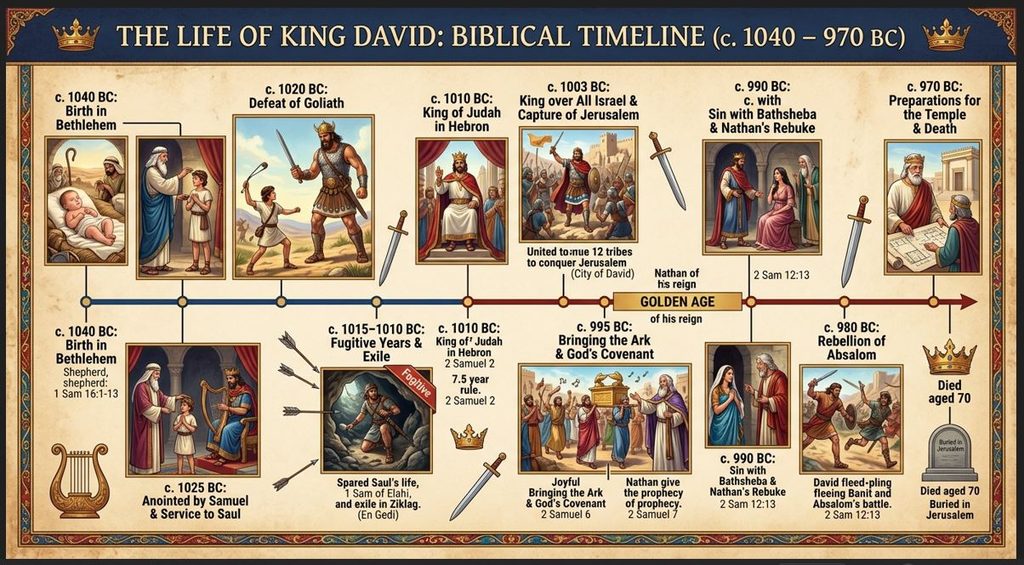
The story of King David is one of the most compelling sagas in ancient history and biblical narrative. Reigning over Israel from approximately 1010 BC to 970 BC, David’s life spans 70 transformative years that reshaped a loose confederation of tribes into a united, powerful kingdom (2 Samuel 5:4–5).
Humble Beginnings in Bethlehem (c. 1040–1025 BC)
Born around 1040 BC in Bethlehem, David was the youngest of eight sons born to Jesse of the tribe of Judah (1 Samuel 16:1–11). Overlooked by his family, young David spent his early years as a shepherd, tending his father’s flocks in the Judean hills—a role that taught him courage, resourcefulness, and deep devotion to God (1 Samuel 17:34–37).
David’s destiny changed dramatically around 1025 BC when the prophet Samuel, instructed by God after the divine rejection of King Saul, secretly anointed the young shepherd as the future king of Israel (1 Samuel 16:12–13). Shortly thereafter, David entered royal service, joining King Saul’s court as a musician whose harp playing calmed the king’s tormented spirit (1 Samuel 16:14–23).
The Hero and the Outlaw (c. 1020–1010 BC)
David’s rise to national prominence began in the Valley of Elah around 1020 BC. Armed with only a sling, five smooth stones, and unwavering faith, David defeated the Philistine champion Goliath of Gath (1 Samuel 17:40–51). This extraordinary victory made David an instant hero, earning him a command position in Saul’s military and the lifelong friendship of Saul’s son, Jonathan (1 Samuel 18:1–5).
However, David’s popularity provoked intense jealousy from King Saul (1 Samuel 18:6–9). What followed was a decade of exile and survival (c. 1015–1010 BC). Forced to flee for his life with the aid of Jonathan and his wife Michal (1 Samuel 19:11–18; 1 Samuel 20), David led a band of outlaws through the wilderness of Judea, hiding in places like Adullam and En Gedi (1 Samuel 22:1–2; 1 Samuel 24:1–2). Despite twice having the opportunity to assassinate King Saul, David spared the king’s life out of respect for God’s anointed leader (1 Samuel 24:3–7; 1 Samuel 26:7–12). Eventually, David sought refuge as a vassal under King Achish of Gath in the Philistine territory of Ziklag (1 Samuel 27:1–7).
The Crown at Hebron and a United Kingdom (c. 1010–1003 BC)
The turning point came around 1010 BC when King Saul and Jonathan were killed in battle against the Philistines at Mount Gilboa (1 Samuel 31:1–6). Mourning their deaths in a famous lamentation (2 Samuel 1:17–27), David returned to Judah and was anointed King over Judah at Hebron at age 30, where he ruled for seven and a half years (2 Samuel 2:1–4, 11).
Following a civil war with Saul’s remaining son, Ish-bosheth, and general Abner (2 Samuel 2:8–3:1), the northern tribes submitted to David’s leadership around 1003 BC, crowning him king over all 12 tribes of Israel (2 Samuel 5:1–3). Immediately seeking a neutral capital, David captured the Jebusite stronghold on Mount Zion, establishing Jerusalem as the political and spiritual capital of the United Kingdom (2 Samuel 5:6–9).
The Golden Age and the Covenant (c. 995 BC)
With Jerusalem secured, David brought the Ark of the Covenant into the city with great celebration, re-establishing Israel’s worship at the heart of the nation (2 Samuel 6:1–19). Around 995 BC, God established the landmark Davidic Covenant through the prophet Nathan, promising that David’s royal throne and lineage would endure forever—a promise foundational to Messianic tradition (2 Samuel 7:8–16).
Under David’s military leadership, Israel expanded its borders, defeating neighboring rivals including the Philistines, Moabites, Arameans, Edomites, and Ammonites (2 Samuel 8:1–14; 2 Samuel 10).
Personal Tragedy and Royal Rebellion (c. 990–980 BC)
Despite his massive achievements, David’s reign was marked by severe personal failure. Around 990 BC, David committed adultery with Bathsheba and orchestrated the death of her husband, Uriah the Hittite, on the battlefield (2 Samuel 11:1–27). When confronted by Nathan the prophet, David offered no excuses, uttering “I have sinned against the Lord” (2 Samuel 12:1–13) and penning heartfelt prayers of repentance in Psalm 51. Though forgiven, David faced severe internal turmoil as a consequence (2 Samuel 12:10–14).
Around 980 BC, David’s third son Absalom staged a civil rebellion, forcing the aging king to temporarily flee Jerusalem (2 Samuel 15:1–14). Though the rebellion was ultimately crushed in the Forest of Ephraim and the kingdom restored, the death of Absalom at the hands of Joab left David deeply heartbroken (2 Samuel 18:5–33).
Legacy and Death (c. 970 BC)
In his final years, David laid the groundwork for Israel’s future. Forbidden by God from building the Temple because he was a man of war (1 Chronicles 22:7–8), David purchased the threshing floor of Araunah on Mount Moriah and gathered vast building materials and architectural plans for the project (2 Samuel 24:18–25; 1 Chronicles 22:1–5).
Around 970 BC, after quelling a succession plot by his son Adonijah (1 Kings 1:5–40), David officially crowned his son Solomon as king (1 Kings 1:38–48). David passed away at age 70 after ruling for 40 years—7½ years in Hebron and 33 years in Jerusalem (1 Kings 2:10–11; 1 Chronicles 29:26–28). Buried in the City of David, he left behind an enduring legacy as Israel’s greatest king, an inspired psalmist (2 Samuel 23:1), and “a man after God’s own heart” (1 Samuel 13:14; Acts 13:22).