Jerusalem: The Epic History of the Holy City
For over four millennia, a small ridge in the Judean Mountains has commanded the spiritual and geopolitical focus of the world. Jerusalem—known across eras as Salem, Jebus, Aelia Capitolina, and Al-Quds—has been built, destroyed, rebuilt, and fought over more than almost any other city in human history. Its story is an epic narrative of faith, conquest, destruction, and enduring resurrection.
The Ancient Roots: Canaanites and the Dawn of Jerusalem (c. 2000–1800 BC)
Long before it became a royal capital or religious center, Jerusalem was a Bronze Age settlement perched near the fertile Gihon Spring. The earliest written records referencing the site appear in ancient Egyptian “Execration Texts” from the 20th to 19th centuries BC, where it was named Rusalimum.
In biblical tradition, this early period is highlighted by the encounter between the patriarch Abraham and Melchizedek, king of Salem (widely identified as early Jerusalem), who blessed Abraham and offered bread and wine—a moment that marked the city’s initial entry into sacred scripture (Genesis 14:18–20).
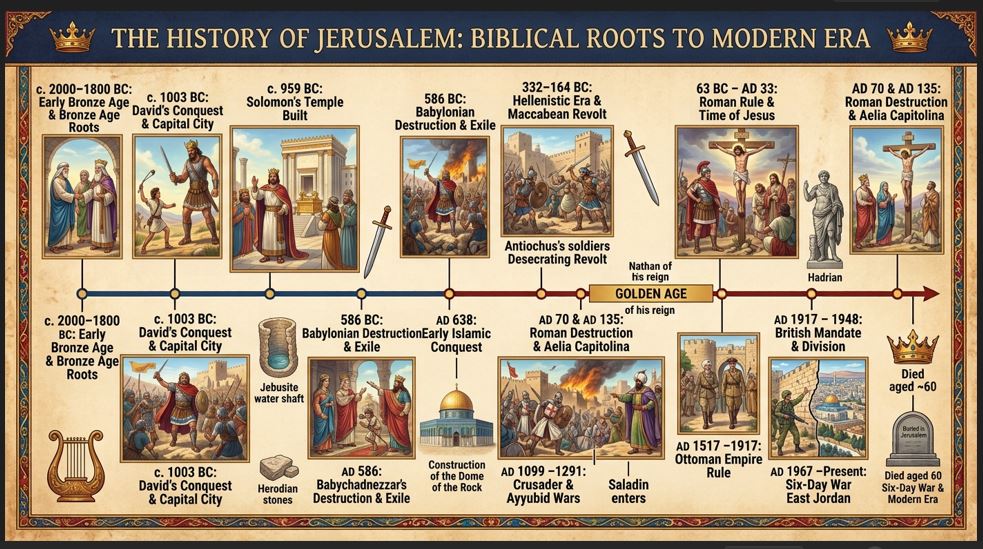
The Royal Capital: David and Solomon (c. 1003–959 BC)
For centuries, Jerusalem remained a fortified stronghold under the control of the Jebusites. That changed around 1003 BC, when King David conquered the Jebusite fortress on Mount Zion. Recognizing its strategic location on the border between the northern and southern tribes, David made Jerusalem the political and religious capital of the united Kingdom of Israel, naming it the City of David (2 Samuel 5).
David’s son and successor, King Solomon, elevated the city’s status globally. In approximately 959 BC, Solomon completed the First Temple on Mount Moriah to house the Ark of the Covenant. The Temple anchored Jerusalem as the spiritual heart of Israelite worship, initiating a golden age of architecture, trade, and regional influence.
Siege, Destruction, and Rebirth: Babylon and Persia (586–445 BC)
Jerusalem’s golden era was shattered in 586 BC when King Nebuchadnezzar II of Babylon laid siege to the city. The Babylonian forces breached the walls, burned Solomon’s Temple to the ground, and forced the Judean population into exile in Babylon.
The city lay in ruins for decades until 538 BC, when Cyrus the Great of Persia conquered Babylon and issued a decree allowing the exiled Jews to return to their homeland. Under the leadership of Zerubbabel, returnees constructed the Second Temple (completed c. 516 BC). Decades later, around 445 BC, Nehemiah rebuilt the city’s defensive walls, restoring security and stability to Jerusalem.
Hellenism, Desecration, and the Maccabees (332–164 BC)
With the conquest of the Persian Empire by Alexander the Great in 332 BC, Jerusalem entered the Hellenistic sphere. Following Alexander’s death, the region was contested between rival Greek dynasties, eventually falling under the rule of the Seleucids.
In 167 BC, Seleucid ruler Antiochus IV Epiphanes outlawed Jewish religious practices and desecrated the Second Temple by placing an altar to Zeus within its courts. This tyranny ignited the Maccabean Revolt, a guerrilla war led by Judas Maccabeus and his brothers. In 164 BC, the Jewish rebels successfully liberated Jerusalem and rededicated the Temple—an event commemorated to this day by the holiday of Hanukkah—establishing the independent Hasmonean Kingdom.
The Roman Era and the Time of Jesus (63 BC – AD 135)
Roman imperial expansion reached Jerusalem in 63 BC when General Pompey captured the city, bringing Judea under Roman oversight.
Under the reign of Herod the Great (appointed King of Judea by Rome), Jerusalem underwent massive architectural expansion starting around 20 BC. Herod enlarged the Temple Mount platform and rebuilt the Second Temple into one of the wonders of the ancient Mediterranean world.
It was in this Roman landscape, during the procuratorship of Pontius Pilate (c. AD 30–33), that Jesus of Nazareth carried out his ministry in and around Jerusalem, leading to his trial, crucifixion, and resurrection. These events transformed Jerusalem into the birthplace of Christianity.
Tensions between Jewish residents and Roman authorities exploded in AD 66 with the First Jewish Revolt. In AD 70, Roman legions under Titus breached Jerusalem’s walls and completely destroyed the city and the Second Temple. A second revolt, led by Simon Bar Kokhba in AD 135, resulted in Emperor Hadrian leveling the remaining ruins, renaming the city Aelia Capitolina, banning Jews from entering, and renaming the surrounding province Syria Palaestina.
The Byzantine and Early Islamic Empires (AD 326–705)
Jerusalem’s fortune transformed once again when Roman Emperor Constantine legalized Christianity in AD 313. In AD 326, his mother, Empress Helena, journeyed to Jerusalem to identify holy sites. She commissioned the construction of grand basilicas, including the Church of the Holy Sepulchre (dedicated AD 335), turning Byzantine Jerusalem into a major center of Christian pilgrimage.
In AD 638, the Second Caliph of Islam, Umar ibn al-Khattab, accepted the city’s surrender from Byzantine Patriarch Sophronius. Under Islamic rule, Jerusalem was recognized as a holy sanctuary (Al-Quds). The Umayyad Caliphate commissioned two iconic architectural landmarks on the Temple Mount platform (Haram al-Sharif):
- The Dome of the Rock, completed in AD 691 under Caliph Abd al-Malik.
- The Al-Aqsa Mosque, completed in AD 705.
The Crusades and Saladin (AD 1099–1291)
In 1099, Western European armies launched the First Crusade, capturing Jerusalem from Fatimid control. The Crusaders established the Kingdom of Jerusalem, converting Islamic holy sites into Christian churches and forbidding Jewish and Muslim settlement within the city.
This Crusader Kingdom lasted until 1187, when the Ayyubid Sultan Saladin defeated the Crusader forces at the Battle of Hattin and recaptured Jerusalem. Unlike the Crusader conquerors, Saladin permitted Jews and Muslims to resettle in the city and granted Christians access to their holy places.
Ottoman Rule and modern Rebuilding (AD 1517–1917)
Jerusalem came under the authority of the Ottoman Empire in 1517. During the reign of Sultan Suleiman the Magnificent (1520–1566), the city experienced a civic revival. Between 1537 and 1541, Suleiman directed the reconstruction of the massive stone walls, towers, and gates surrounding the Old City—the very walls that define Jerusalem’s historic core today.
For four centuries, Jerusalem developed as a provincial Ottoman administrative center where Jewish, Christian, and Muslim communities lived under the millet system. In the mid-19th century, expansion beyond the Old City walls began, establishing the first modern neighborhoods of New Jerusalem.
The British Mandate and the Modern Era (1917 – Present)
In December 1917, during World War I, British forces commanded by General Edmund Allenby entered Jerusalem, ending 400 years of Ottoman dominance and initiating the British Mandate era.
Following World War II and the end of the British Mandate, the 1948 Arab-Israeli War left Jerusalem physically divided:
- West Jerusalem came under the control of the newly declared State of Israel.
- East Jerusalem, including the Old City and its sacred sites, was controlled by the Kingdom of Jordan.
During the Six-Day War in June 1967, Israeli forces captured East Jerusalem, reunifying the city under Israeli jurisdiction and opening access to holy sites for believers of all faiths.
Today, Jerusalem stands as a living tapestry of human history—a bustling modern metropolis where ancient stones, sacred traditions, and global diplomacy intersect every day.