King Solomon: The Golden Age of Israel’s Wisdom and Splendor
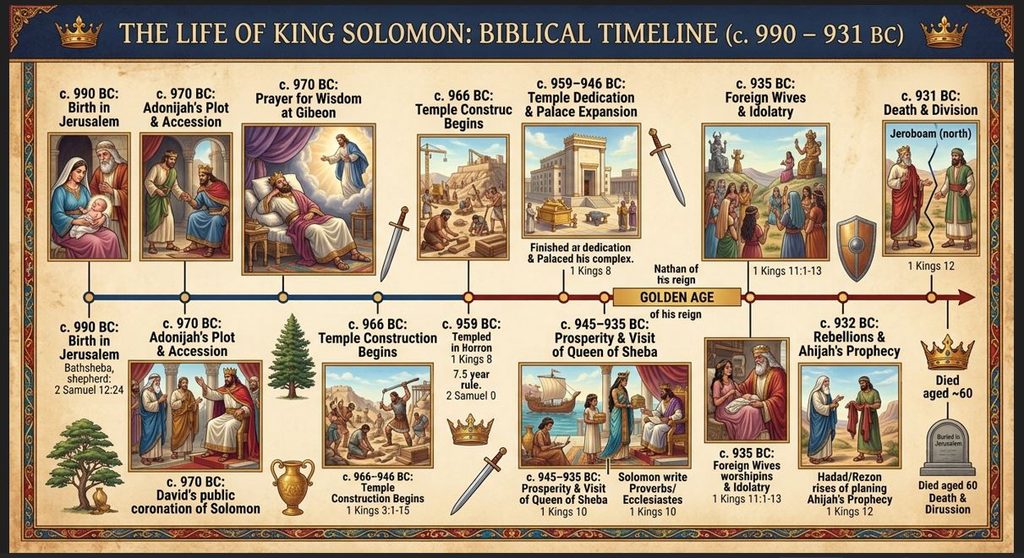
The reign of King Solomon marks the zenith of the United Kingdom of Israel. Governing from approximately 970 BC to 931 BC, Solomon oversaw an era defined not by military conquest, but by unprecedented peace, vast wealth, architectural marvels, and monumental wisdom (1 Kings 4:20–25). His 40-year reign represents both the peak of Israel’s golden age and the tragic seedbed of its eventual division.
Birth and Royal Succession (c. 990–970 BC)
Solomon was born in Jerusalem to King David and Bathsheba (2 Samuel 12:24). The prophet Nathan named him Jedidiah, meaning “Beloved of the Lord,” signifying divine favor over his life from infancy (2 Samuel 12:25).
As King David grew old and frail around 970 BC, his eldest surviving son, Adonijah, attempted to usurp the throne (1 Kings 1:5–10). Prompted by Nathan and Bathsheba, David acted swiftly, ordering that Solomon be anointed king at the Gihon Spring (1 Kings 1:32–40). After David’s death, the young king secured his reign by removing key political threats, including Adonijah and General Joab (1 Kings 2:13–35).
The Gift of Wisdom (c. 970 BC)
Early in his reign, Solomon traveled to the high place at Gibeon to offer sacrifices. That night, God appeared to him in a dream, saying, “Ask! What shall I give you?” (1 Kings 3:5). Recognizing the heavy burden of ruling Israel, Solomon humbly requested an understanding heart to judge the people and discern between good and evil (1 Kings 3:7–9).
Pleased that Solomon asked for wisdom rather than long life, riches, or the death of his enemies, God granted him unmatched wisdom and insight, along with honor and riches beyond any contemporary monarch (1 Kings 3:10–13). Solomon’s wisdom became legendary across the ancient world, famously demonstrated in his judgment between two mothers claiming the same living infant (1 Kings 3:16–28).
The First Temple and Building Campaigns (c. 966–946 BC)
In the fourth year of his reign (c. 966 BC), Solomon initiated the grandest project in Israel’s history: the construction of the First Temple on Mount Moriah in Jerusalem, fulfilling the dream of his father David (1 Kings 5–6; 2 Chronicles 2–3). Partnering with King Hiram of Tyre for cedar, cypress, and skilled artisans, Solomon spent seven years building the sanctuary (1 Kings 5:1–12; 6:37–38).
Upon its completion around 959 BC, the Ark of the Covenant was brought into the Holy of Holies, and the glory of the Lord filled the Temple (1 Kings 8:1–11). Solomon followed this achievement with a 13-year construction program for his royal palace complex, the Hall of Judgment, and extensive fortifications throughout Israel, including Hazor, Megiddo, and Gezer (1 Kings 7:1–8; 9:15).
Global Fame and Prosperity (c. 945–935 BC)
Under Solomon, Israel became an international economic powerhouse. Positioned at the crossroads of major trade routes, Solomon built a merchant fleet at Ezion-geber (1 Kings 9:26–28) and controlled trade in gold, silver, horses, and spices (1 Kings 10:28–29).
Solomon also excelled as a literary figure and sage, authoring 3,000 proverbs and 1,005 songs (1 Kings 4:32), traditionally including large portions of Proverbs, Ecclesiastes, and the Song of Solomon. His reputation drew dignitaries from afar, most notably the Queen of Sheba, who visited Jerusalem with a massive caravan to test his wisdom and declared that “the half was not told me” (1 Kings 10:1–7).
Foreign Wives, Idolatry, and Decline (c. 935–932 BC)
Despite his unmatched wisdom, Solomon violated divine commands regarding kingship laid out in Deuteronomy 17:14–20. He accumulated vast wealth, built a massive chariot force, and took 700 wives of royal birth alongside 300 concubines from surrounding pagan nations (1 Kings 11:1–3).
In his older years, his foreign wives turned his heart after other gods. Solomon committed severe spiritual compromise by building high places for pagan deities such as Ashtoreth, Chemosh, and Molech on the hill east of Jerusalem (1 Kings 11:4–8). Consequently, God declared that the kingdom would be torn away from his line, leaving only a small remnant for the sake of David (1 Kings 11:9–13). Adversaries such as Hadad the Edomite and Rezon of Damascus arose against him, while the prophet Ahijah prophesied that Jeroboam would take ten of Israel’s tribes (1 Kings 11:14–40).
Death and the Fractured Kingdom (c. 931 BC)
Solomon died in Jerusalem around 931 BC after ruling for 40 years, and was buried in the City of David (1 Kings 11:42–43).
His death triggered an immediate national crisis. When his son and successor, Rehoboam, rejected the elders’ counsel and refused to lighten the heavy taxation and forced labor imposed during Solomon’s reign, the ten northern tribes rebelled (1 Kings 12:1–16). The United Kingdom split permanently into the Northern Kingdom of Israel (led by Jeroboam) and the Southern Kingdom of Judah (led by Rehoboam), ending the golden era of united Israelite rule (1 Kings 12:17–20).