Position Precedes Providence: How Faith, Preparation, and Diligence Manufacture Opportunity
We often treat major breakthroughs as divine lightning bolts—unexpected moments of luck or grace that strike out of nowhere. We marvel at the entrepreneur who secures an unexpected investor, the creative whose work suddenly resonates with millions, or the scientist who stumbles upon a world-changing revelation.
Society labels these moments as pure coincidence or sudden blessings. But extraordinary breaks are rarely as accidental as they appear. Wisdom ancient, biblical, and modern reveals a foundational truth about human achievement: providence is not merely encountered; it is invited through deliberate preparation.
As the great 19th-century microbiologist Louis Pasteur famously observed in his 1854 lecture: “In the fields of observation, chance favors only the prepared mind.”
Pasteur was tapping into a reality that spans human history. Fortune is not a blind lottery—it is an answer to placement. Position precedes providence.
The Wisdom of Preparation
In both classical history and biblical tradition, human effort and divine timing are deeply intertwined. Providence requires a vessel to fill. The ancient Romans declared “Audantes fortuna iuvat” (Fortune favors the bold), but spiritual and practical tradition takes it a step further: God and destiny honor those who actively place themselves in a posture of readiness.
Consider the practical wisdom of the Proverbs:
“The plans of the diligent lead surely to abundance, but everyone who is hasty comes only to poverty.”
— Proverbs 21:5
True diligence is not just working hard; it is placing your life in the right location long before the harvest arrives. The ancient texts frequently point to nature to illustrate this principle. The ant doesn’t wait for summer to search for food; it prepares its provisions beforehand so that when winter comes, it is already positioned to survive (Proverbs 6:6–8).
Similarly, when Paul writes to the ancient churches, he urges believers to “make the most of every opportunity” (Colossians 4:5, Ephesians 5:16). The original Greek term used here for opportunity is kairos—meaning an appointed, decisive moment. You cannot seize a kairos moment if you are standing in the wrong place when it arrives.
Expanding Your Surface Area for Grace
Positioning yourself is the deliberate act of stepping onto the field before the play is called. It operates across three distinct dimensions:
- Environmental Positioning: Placing yourself physically and digitally in environments where wisdom, agency, and decision-making density are highest.
- Capability Positioning: Sharpening your skills in quiet seasons—what Ecclesiastes 10:10 calls “sharpening the edge” of the axe—so that when an opening appears, your “prepared mind” can immediately spot and seize it.
- Relational & Moral Positioning: Building genuine trust, integrity, and goodwill with others. As Proverbs 22:29 notes, “Do you see a man skillful in his work? He will stand before kings.”
By taking these steps, you are not forcing an outcome on your own arbitrary schedule. Instead, you are vastly expanding your surface area for grace and unexpected doors to open.
Constructing the Opening
To “make chance” means shifting your mindset from a passive spectator to an active steward of your circumstances. You don’t wait idle until an invitation arrives; you build the pathway yourself.
Creating opportunity comes down to three active habits:
- Initiate Motion Early: Perfect conditions rarely exist. Ecclesiastes 11:4 warns, “He who observes the wind will not sow, and he who regards the clouds will not reap.” Motion creates momentum, and momentum attracts resourcefulness.
- Broadcast Clear Intentions: Be transparent about your mission and goals. When you signal clear direction, others know how to route unexpected ideas and opportunities to your door.
- Cultivate Proximity: Surround yourself with high-agency people. Being routinely close to dynamic, faith-filled, and ambitious individuals exponentially increases the rate at which fortunate collisions occur.
Faith Meets Placement
When inspecting any “overnight success,” a close look at the timeline almost always reveals a long, quiet stretch of intentional placement and mental preparation. The stroke of divine alignment or scientific discovery was real, but it landed because the individual was already standing in the exact spot required to receive it.
As the old proverb reminds us, “The horse is made ready for the day of battle, but victory belongs to the Lord” (Proverbs 21:31). You must prepare the horse, sharpen the mind, and set your sail into deep waters.
Set your position—and providence will take care of the rest.
________________________________________________
Cedar Grace Systems • Operational Architecture
The Tripartite Engine: Modern Resilience via Solomon’s 33/33/33 Rule
Published for CedarGraceSystems.com
In an era dominated by hyper-speculation, volatile markets, and fragile corporate frameworks, true structural stability is rarely found by chasing the latest macroeconomic trend. Instead, the blueprint for building an unshakeable enterprise often requires looking backward. Long before modern financial theory, an elegant risk-management system laid the groundwork for an empire’s golden age.
Commonly known as the 33/33/33 Rule—or the classic framework of tripartite stewardship—this system avoids the traps of modern over-leverage. Rather than betting on a singular vector, it splits total operational and capital resources into three perfectly balanced, structurally independent pillars. The goal is simple: structural resilience that ensures an organization survives single points of failure, scaling uniformly whether managing the baseline deployment of a local project or a diversified, multi-state enterprise.
Pillar 1: Land & Hard Assets (The Anchor)
The first allocation demands that exactly one-third of capital reside in tangible, slow-moving, protective infrastructure. In historical terms, this was physical land and agricultural holdings. Today, it translates to real estate equity, commercial facilities, or physical land ownership.
This pillar does not exist to drive rapid weekly margins; its purpose is defense. Hard assets provide an unshakeable asset base, protect capital from the corrosive effects of high inflation, and ensure that the core entity retains intrinsic value regardless of what happens to the broader paper economy. It is the solid ground upon which all active systems sit.
Pillar 2: Trade & Operations (The Engine)
The second third is explicitly designated as working capital for active growth, high-margin business operations, and enterprise development. This is where capital is actively exposed to the market to generate velocity, produce high-margin returns, and compound income.
Whether deployed into inventory, structural development, digital infrastructure, or commercial ventures, this pillar functions as the entity’s growth engine. It inherently carries a higher risk profile than hard land assets, but it provides the essential cash flow needed to fuel expansion and capitalize on high-yielding operational margins.
Pillar 3: Absolute Liquidity (The Shield)
The final allocation requires maintaining a highly accessible, liquid reserve—traditionally kept in precious metals, but modernly held in cash, high-yield accounts, or short-term treasury allocations. Many builders compromise this pillar in a frantic race for immediate yield, which introduces immense fragility into their systems.
Under the 33/33/33 architecture, absolute liquidity serves a dual function:
- Insulation from Strain: It guarantees that a poor season or an operational delay in the business pillar never forces the premature sale or liquidation of your hard asset base.
- Opportunistic Execution: It keeps the entity agile. When market corrections or economic downturns stress external competitors, an organization with a liquid third can instantly pivot, securing deeply discounted infrastructure and assets from a position of absolute strength.
The Law of Scalability
The ultimate power of this architectural framework lies in its absolute consistency. The mathematical ratio behaves identically across every tier of deployment. The structural balance required to manage a localized startup project scales flawlessly when transitioning to high-level commercial or corporate scaling. It prioritizes systemic survival over short-sighted speculation, creating a modular, self-sustaining financial posture designed to endure for generations.
This article is part of the ongoing strategic architecture series for leaders and builders looking to design resilient systems in an unpredictable world. Learn more at CedarGraceSystems.com.
________________________________________________________________
The Wisdom of Solomon is one of the most prominent books of the Biblical Apocrypha (or Deuterocanonical books), known for its beautiful blending of traditional Jewish theology with Hellenistic Greek philosophy. Written in the guise of King Solomon—the biblical archetype of supreme insight—it served as a profound survival guide for ancient people fighting to maintain their identity in a rapidly changing world.
The Wisdom of Solomon: A Bridge Across the Ancient World
By the late first century BCE, the Jewish community in Alexandria, Egypt, found itself at a cultural crossroads. Alexandria was the roaring intellectual capital of the Mediterranean, dominated by Greek language, philosophy, and social prestige. For the local Jewish population, the pressure to assimilate was immense. Traditional laws and customs were increasingly viewed as outdated or provincial compared to the high-minded philosophies of Plato and the Stoics.
It was during this era of deep cultural tension that an anonymous, highly educated Alexandrian Jew picked up a stylus. To give his words the ultimate authority, he wrote pseudepigraphally—adopting the literary persona of King Solomon, the historical king famous for requesting wisdom above all riches.
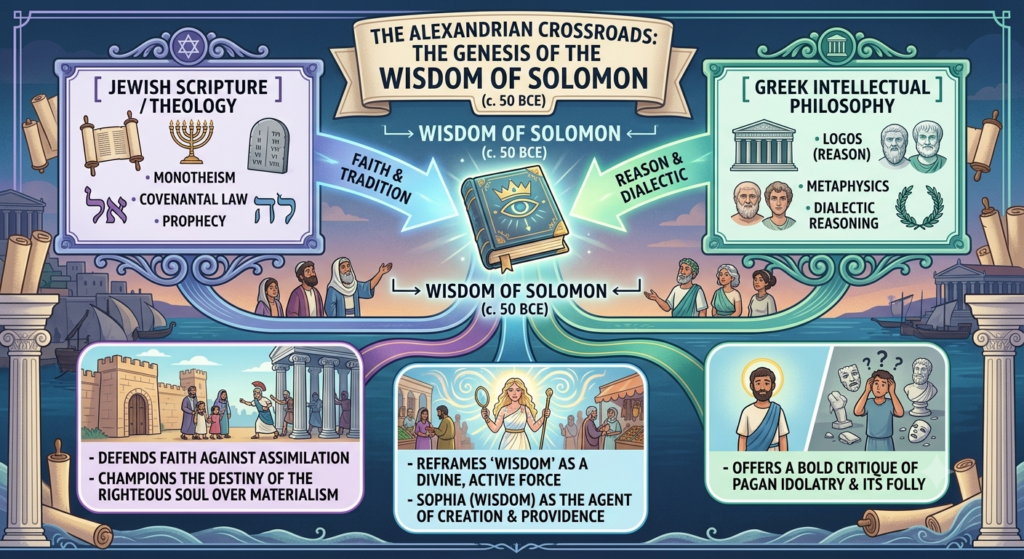
Written in elegant Greek but saturated with Hebrew thought, the text was a masterpiece of cultural defense. It didn’t just reject Greek culture; it hijacked Greek philosophical concepts to argue that true wisdom—the highest virtue sought by any philosopher—was originally given by the God of Israel.
Through poetry, warnings, and a reimagining of history, the book sought to remind its readers that staying true to their heritage wasn’t just a matter of law, but the only path to immortality.
The Wisdom of Solomon is traditionally divided into three distinct sections, each tackling a different facet of what it means to live wisely.
1. The Eschatological Section: Wisdom and Destiny (Chapters 1–5)
This opening section addresses the existential crisis of the righteous sufferer. It directly counters the popular, nihilistic philosophy of the time, which argued that life is short and meaningless, so one should indulge in pleasure and oppress the weak.
- The Call to Righteousness: Rulers and individuals are urged to love justice, as wickedness blinds the soul to reality.
- The Illusion of the Wicked: A dramatic contrast between the materialistic worldview of the ungodly and the true destiny of the soul.
- Immortality as the Reward: The author introduces a vital theological development: physical suffering or early death is not a punishment, but a refining process. The souls of the righteous rest safely in the hands of God.
2. The Philosophical Section: The Nature of Wisdom (Chapters 6–9)
Here, the pseudo-Solomonic voice speaks directly. The author praises Sophia (Wisdom) not just as a human trait, but as a cosmic, divine entity.
- Solomon’s Search: “Solomon” recounts how he, a mere mortal, prayed for Wisdom rather than kingdoms, wealth, or health, and received all other blessings as a result.
- The Cosmic Power of Sophia: Wisdom is described using vivid philosophical language as “a breath of the power of God” and “a reflection of eternal light.” She permeates, sustains, and guides the entire universe.
- The Prayer for Wisdom: Chapter 9 stands as a centerpiece prayer, asking God to send Wisdom down from the holy heavens to guide human actions, which are otherwise fragile and short-sighted.
3. The Historical Section: Wisdom in Action and the Folly of Idols (Chapters 10–19)
The final, longest section shifts from abstract philosophy to concrete history. It uses a literary technique known as a syncrisis—a sustained, point-by-point comparison—to show how Wisdom has guided history, specifically during the Exodus.
- The Heroes of Faith: Chapter 10 traces history from Adam to Moses, showing how Wisdom rescued the righteous at every major crisis (Noah from the flood, Abraham from temptation, Lot from Sodom).
- The Retribution of Egypt vs. The Blessing of Israel: The author compares the plagues of Egypt with the miracles in the desert. For example, while the Egyptians suffered from water turned to blood, the Israelites were sustained by water from a rock.
- The Critique of Idolatry (Chapters 13–15): A famous, biting critique of paganism. The author argues that worshiping nature or man-made idols is the root of all moral decay, describing how a woodcutter carves a god out of scraps and then prays to it for safety.
A Lasting Legacy: While the Wisdom of Solomon did not make it into the Hebrew Bible, it deeply influenced the New Testament writers (particularly in the Apostle Paul’s theology of Christ and the opening of the Gospel of John) and remains a prized canonical book within the Roman Catholic and Eastern Orthodox traditions today.
__________________________________________________________________
____________C E D A R G R A C E S Y S T E M S • P E R S P E C T I V E S E R I E S
From Passion to Paradox: The Three Lifetimes of King Solomon
Published for CedarGraceSystems.com
Few figures in ancient history capture the imagination quite like King Solomon. Renowned for his unparalleled wealth, sprawling kingdom, and divinely gifted intellect, his legacy is deeply etched into the fabric of human history. Yet, his most profound contribution remains literary: three distinct books of the
Bible that traces the fascinating evolution of a human soul from the heights of youthful romance to the quiet realism of old age. [cite: 1] According to enduring Jewish tradition, Solomon’s literary contributions were not written all at once. Instead, they reflect three distinct epochs of his life. Taken together, they form a remarkably honest trilogy of the human
condition, capturing the shifting priorities of youth, midlife, and the final years of reflection. [cite: 1]
THE SONG OF SOLOMON: THE FIRE OF YOUTH
Written in the vibrant dawn of his life, the Song of Solomon (also known as the Song of Songs) is an intense,exquisitely crafted anthology of love poetry. Unlike any other book in the biblical canon, it famously avoids the
mechanics of religious law, national history, or explicit theological exposition. Instead, it turns its lens fully on the beauty of human romance and marital intimacy. [cite: 1]
On a literal level, the poetry vividly captures the mutual devotion, physical attraction, and emotional weight of love between a young bridegroom and his bride. However, generations of theologians have seen a deeper, allegorical
dimension within its verses. In Jewish tradition, it beautifully mirrors the profound love between God and Israel; for Christian readers, it serves as a powerful metaphor for the devotion between Christ and the Church. [cite: 1]
THE BOOK OF PROVERBS: THE PRUDENCE OF MIDLIFE
As Solomon entered maturity and assumed the full weight of leadership, his writing shifted from poetry to practicality. According to biblical accounts, when offered any gift by God, Solomon requested an “understanding
heart” to govern effectively. The Book of Proverbs stands as the enduring monument to that answered prayer. [cite:1]
Serving as an essential handbook for daily living, Proverbs offers sharp, actionable advice designed to navigate a complex world. Solomon systematically contrasts the path of the “wise person” with that of the “fool,” exploring foundational life dynamics such as: [cite: 1]
Financial Discipline: The vital importance of honest labor, generosity, and avoiding the traps of debt. [cite: 1] Personal Conduct: The mastery over anger, the value of choosing upright companions, and the heavy impact of our words. [cite: 1] The Foundation of Wisdom: A recurring insistence that all meaningful intelligence begins with a deep,
reverent awe of the Creator. [cite: 1]
ECCLESIASTES: THE REALISM OF OLD AGE
In the winter of his life, having experienced every comfort, luxury, and triumph the world could provide, Solomon authored his most provocative work: Ecclesiastes. It reads like the raw, uncensored journal of an aging monarch who has discovered that earthly success does not automatically guarantee internal peace. [cite: 1]
The book opens with one of the most famous declarations in literature: “Vanity of vanities, all is vanity”—a phrase better translated from the original Hebrew as “vapor” or “meaningless.” Solomon illustrates how chasing after fame, status, and material abundance is ultimately akin to “chasing the wind.” [cite: 1]
“The conclusion of the matter, when all has been heard, is this: fear God and keep His commandments, for this applies to every person.” [cite: 1]
Yet, despite its heavy tone, Ecclesiastes does not despair. It arrives at a grounded, beautiful conclusion: true
contentment is found by shifting our gaze away from endless ambition and learning to gratefully accept the simple
blessings of today—good food, meaningful work, and an enduring reverence for God. [cite: 1]
A Historical Postscript: Beyond these three foundational texts, ancient tradition also credits Solomon with composing Psalms 72 and
While modern scholarship notes that later scribes and editors likely compiled and polished these vellum scrolls over centuries, the foundational voice remains unmistakably Solomon’s—a king who lived fully, thought deeply, and left behind a roadmap for every stage of life’s journey. [cite: 1]
________________________________________________________
__________________
Song of Solomon — 8 Chapters
Chapter 1
- The song of songs, which is Solomon’s.
- Let him kiss me with the kisses of his mouth: for thy love is better than wine.
- Because of the savour of thy good ointments thy name is as ointment poured forth, therefore do the virgins love thee.
- Draw me, we will run after thee: the king hath brought me into his chambers: we will be glad and rejoice in thee, we will remember thy love more than wine: the upright love thee.
- I am black, but comely, O ye daughters of Jerusalem, as the tents of Kedar, as the curtains of Solomon.
- Look not upon me, because I am black, because the sun hath looked upon me: my mother’s children were angry with me; they made me the keeper of the vineyards; but mine own vineyard have I not kept.
- Tell me, O thou whom my soul loveth, where thou feedest, where thou makest thy flock to rest at noon: for why should I be as one that turneth aside by the flocks of thy companions?
- If thou know not, O thou fairest among women, go thy way forth by the footsteps of the flock, and feed thy kids beside the shepherds’ tents.
- I have compared thee, O my love, to a company of horses in Pharaoh’s chariots.
- Thy cheeks are comely with rows of jewels, thy neck with chains of gold.
- We will make thee borders of gold with studs of silver.
- While the king sitteth at his table, my spikenard sendeth forth the smell thereof.
- A bundle of myrrh is my wellbeloved unto me; he shall lie all night betwixt my breasts.
- My beloved is unto me as a cluster of camphire in the vineyards of Engedi.
- Behold, thou art fair, my love; behold, thou art fair; thou hast doves’ eyes.
- Behold, thou art fair, my beloved, yea, pleasant: also our bed is green.
- The beams of our house are cedar, and our rafters of fir.
Chapter 2
- I am the rose of Sharon, and the lily of the valleys.
- As the lily among thorns, so is my love among the daughters.
- As the apple tree among the trees of the wood, so is my beloved among the sons. I sat down under his shadow with great delight, and his fruit was sweet to my taste.
- He brought me to the banqueting house, and his banner over me was love.
- Stay me with flagons, comfort me with apples: for I am sick of love.
- His left hand is under my head, and his right hand doth embrace me.
- I charge you, O ye daughters of Jerusalem, by the roes, and by the hinds of the field, that ye stir not up, nor awake my love, till he please.
- The voice of my beloved! behold, he cometh leaping upon the mountains, skipping upon the hills.
- My beloved is like a roe or a young hart: behold, he standeth behind our wall, he looketh forth at the windows, shewing himself through the lattice.
- My beloved spake, and said unto me, Rise up, my love, my fair one, and come away.
- For, lo, the winter is past, the rain is over and gone;
- The flowers appear on the earth; the time of the singing of birds is come, and the voice of the turtle is heard in our land;
- The fig tree putteth forth her green figs, and the vines with the tender grape give a good smell. Arise, my love, my fair one, and come away.
- O my dove, that art in the clefts of the rock, in the secret places of the stairs, let me see thy countenance, let me hear thy voice; for sweet is thy voice, and thy countenance is comely.
- Take us the foxes, the little foxes, that spoil the vines: for our vines have tender grapes.
- My beloved is mine, and I am his: he feedeth among the lilies.
- Until the day break, and the shadows flee away, turn, my beloved, and be thou like a roe or a young hart upon the mountains of Bether.
Chapter 3
- By night on my bed I sought him whom my soul loveth: I sought him, but I found him not.
- I will rise now, and go about the city in the streets, and in the broad ways I will seek him whom my soul loveth: I sought him, but I found him not.
- The watchmen that go about the city found me: to whom I said, Saw ye him whom my soul loveth?
- It was but a little that I passed from them, but I found him whom my soul loveth: I held him, and would not let him go, until I had brought him into my mother’s house, and into the chamber of her that conceived me.
- I charge you, O ye daughters of Jerusalem, by the roes, and by the hinds of the field, that ye stir not up, nor awake my love, till he please.
- Who is this that cometh out of the wilderness like pillars of smoke, perfumed with myrrh and frankincense, with all powders of the merchant?
- Behold his bed, which is Solomon’s; threescore valiant men are about it, of the valiant of Israel.
- They all hold swords, being expert in war: every man hath his sword upon his thigh because of fear in the night.
- King Solomon made himself a chariot of the wood of Lebanon.
- He made the pillars thereof of silver, the bottom thereof of gold, the covering of it of purple, the midst thereof being paved with love, for the daughters of Jerusalem.
- Go forth, O ye daughters of Zion, and behold king Solomon with the crown wherewith his mother crowned him in the day of his espousals, and in the day of the gladness of his heart.
Here is the full text for Chapters 4, 5, and 6 of the Song of Solomon using the classic King James Version (KJV), ready to copy and paste.
Chapter 4
- Behold, thou art fair, my love; behold, thou art fair; thou hast doves’ eyes within thy locks: thy hair is as a flock of goats, that appear from mount Gilead.
- Thy teeth are like a flock of sheep that are even shorn, which came up from the washing; whereof every one bear twins, and none is barren among them.
- Thy lips are like a thread of scarlet, and thy speech is comely: thy temples are like a piece of a pomegranate within thy locks.
- Thy neck is like the tower of David builded for an armoury, whereon there hang a thousand bucklers, all shields of mighty men.
- Thy two breasts are like two young roes that are twins, which feed among the lilies.
- Until the day break, and the shadows flee away, I will get me to the mountain of myrrh, and to the hill of frankincense.
- Thou art all fair, my love; there is no spot in thee.
- Come with me from Lebanon, my spouse, with me from Lebanon: look from the top of Amana, from the top of Shenir and Hermon, from the lions’ dens, from the mountains of the leopards.
- Thou hast ravished my heart, my sister, my spouse; thou hast ravished my heart with one of thine eyes, with one chain of thy neck.
- How fair is thy love, my sister, my spouse! how much better is thy love than wine! and the smell of thine ointments than all spices!
- Thy lips, O my spouse, drop as the honeycomb: honey and milk are under thy tongue; and the smell of thy garments is like the smell of Lebanon.
- A garden inclosed is my sister, my spouse; a spring shut up, a fountain sealed.
- Thy plants are an orchard of pomegranates, with pleasant fruits; camphire, with spikenard,
- Spikenard and saffron; calamus and cinnamon, with all trees of frankincense; myrrh and aloes, with all the chief spices:
- A fountain of gardens, a well of living waters, and streams from Lebanon.
- Awake, O north wind; and come, thou south; blow upon my garden, that the spices thereof may flow out. Let my beloved come into his garden, and eat his pleasant fruits.
Chapter 5
- I am come into my garden, my sister, my spouse: I have gathered my myrrh with my spice; I have eaten my honeycomb with my honey; I have drunk my wine with my milk: eat, O friends; drink, yea, drink abundantly, O beloved.
- I sleep, but my heart waketh: it is the voice of my beloved that knocketh, saying, Open to me, my sister, my love, my dove, my undefiled: for my head is filled with dew, and my locks with the drops of the night.
- I have put off my coat; how shall I put it on? I have washed my feet; how shall I defile them?
- My beloved put in his hand by the hole of the door, and my bowels were moved for him.
- I rose up to open to my beloved; and my hands dropped with myrrh, and my fingers with sweet smelling myrrh, upon the handles of the lock.
- I opened to my beloved; but my beloved had withdrawn himself, and was gone: my soul failed when he spake: I sought him, but I could not find him; I called him, but he gave me no answer.
- The watchmen that went about the city found me, they smote me, they wounded me; the keepers of the walls took away my veil from me.
- I charge you, O daughters of Jerusalem, if ye find my beloved, that ye tell him, that I am sick of love.
- What is thy beloved more than another beloved, O thou fairest among women? what is thy beloved more than another beloved, that thou dost so charge us?
- My beloved is white and ruddy, the chiefest among ten thousand.
- His head is as the most fine gold, his locks are bushy, and black as a raven.
- His eyes are as the eyes of doves by the rivers of waters, washed with milk, and fitly set.
- His cheeks are as a bed of spices, as sweet flowers: his lips like lilies, dropping sweet smelling myrrh.
- His hands are as gold rings set with the beryl: his belly is as bright ivory overlaid with sapphires.
- His legs are as pillars of marble, set upon sockets of fine gold: his countenance is as Lebanon, excellent as the cedars.
- His mouth is most sweet: yea, he is altogether lovely. This is my beloved, and this is my friend, O daughters of Jerusalem.
Chapter 6
- Whither is thy beloved gone, O thou fairest among women? whither is thy beloved turned aside? that we may seek him with thee.
- My beloved is gone down into his garden, to the beds of spices, to feed in the gardens, and to gather lilies.
- I am my beloved’s, and my beloved is mine: he feedeth among the lilies.
- Thou art beautiful, O my love, as Tirzah, comely as Jerusalem, terrible as an army with banners.
- Turn away thine eyes from me, for they have overcome me: thy hair is as a flock of goats that appear from Gilead.
- Thy teeth are as a flock of sheep which go up from the washing, whereof every one beareth twins, and there is not one barren among them.
- As a piece of a pomegranate are thy temples within thy locks.
- There are threescore queens, and fourscore concubines, and virgins without number.
- My dove, my undefiled is but one; she is the only one of her mother, she is the choice one of her that bare her. The daughters saw her, and blessed her; yea, the queens and the concubines, and they praised her.
- Who is she that looketh forth as the morning, fair as the moon, clear as the sun, and terrible as an army with banners?
- I went down into the garden of nuts to see the fruits of the valley, and to see whether the vine flourished, and the pomegranates budded.
- Or ever I was aware, my soul made me like the chariots of Amminadib.
- Return, return, O Shulamite; return, return, that we may look upon thee. What will ye see in the Shulamite? As it were the company of two armies.
Here is the final part of the text, completing the book with Chapters 7 and 8 of the Song of Solomon using the classic King James Version (KJV). It is ready for you to copy and paste.
Chapter 7
- How beautiful are thy feet with shoes, O prince’s daughter! the joints of thy thighs are like jewels, the work of the hands of a cunning workman.
- Thy navel is like a round goblet, which wanteth not liquor: thy belly is like an heap of wheat set about with lilies.
- Thy two breasts are like two young roes that are twins.
- Thy neck is as a tower of ivory; thine eyes like the fishpools in Heshbon, by the gate of Bathrabbim: thy nose is as the tower of Lebanon which looketh toward Damascus.
- Thine head upon thee is like Carmel, and the hair of thine head like purple; the king is held in the galleries.
- How fair and how pleasant art thou, O love, for delights!
- This thy stature is like to a palm tree, and thy breasts to clusters of grapes.
- I said, I will go up to the palm tree, I will take hold of the boughs thereof: now also thy breasts shall be as clusters of the vine, and the smell of thy nose like apples;
- And the roof of thy mouth like the best wine for my beloved, that goeth down sweetly, causing the lips of those that are asleep to speak.
- I am my beloved’s, and his desire is toward me.
- Come, my beloved, let us go forth into the field; let us lodge in the villages.
- Let us get up early to the vineyards; let us see if the vine flourish, whether the tender grape appear, and the pomegranates bud forth: there will I give thee my loves.
- The mandrakes give a smell, and at our gates are all manner of pleasant fruits, new and old, which I have laid up for thee, O my beloved.
Chapter 8
- O that thou wert as my brother, that sucked the breasts of my mother! when I should find thee without, I would kiss thee; yea, I should not be despised.
- I would lead thee, and bring thee into my mother’s house, who would instruct me: I would cause thee to drink of spiced wine of the juice of my pomegranate.
- His left hand should be under my head, and his right hand should embrace me.
- I charge you, O daughters of Jerusalem, that ye stir not up, nor awake my love, until he please.
- Who is this that cometh up from the wilderness, leaning upon her beloved? I raised thee up under the apple tree: there thy mother brought thee forth: there she brought thee forth that bare thee.
- Set me as a seal upon thine heart, as a seal upon thine arm: for love is strong as death; jealousy is cruel as the grave: the coals thereof are coals of fire, which hath a most vehement flame.
- Many waters cannot quench love, neither can the floods drown it: if a man would give all the substance of his house for love, it would utterly be contemned.
- We have a little sister, and she hath no breasts: what shall we do for our sister in the day when she shall be spoken for?
- If she be a wall, we will build upon her a palace of silver: and if she be a door, we will enclose her with boards of cedar.
- I am a wall, and my breasts like towers: then was I in his eyes as one that found favour.
- Solomon had a vineyard at Baalhamon; he let out the vineyard unto keepers; every one for the fruit thereof was to bring a thousand pieces of silver.
- My vineyard, which is mine, is before me: thou, O Solomon, must have a thousand, and those that keep the fruit thereof two hundred.
- Thou that dwellest in the gardens, the companions hearken to thy voice: cause me to hear it.
- Make haste, my beloved, and be thou like to a roe or to a young hart upon the mountains of spices.
______________________________________________________
Cedar Grace Systems • Human Dynamics & Reflection
The Dual Map: How the Beatitudes Decode the Self and Identify Those in Need
Published for CedarGraceSystems.com
When looking for a framework to understand human behavior, motivation, and needs, we often turn to modern psychology. Yet, one of the most sophisticated behavioral blueprints ever spoken sits at the very beginning of the Sermon on the Mount. The Beatitudes are not merely comforting prose; they function as a precise, dual-layered map.
To the strategic builder, the counselor, or the community leader, this ancient text serves two profound operational purposes simultaneously: it is an internal compass to audit and align one’s own character, and an external radar to identify exactly who in our environment is vulnerable, straining, and positioned to benefit from intervention.
The External Radar: Mapping Those Who Can Benefit
Effective service, leadership, and product deployment require knowing exactly who needs your support. The Beatitudes systematically name and categorize specific states of human vulnerability and readiness, offering a diagnostic checklist to spot individuals who are ripe for a helping hand:
- The “Poor in Spirit” and “Those Who Mourn”: These are individuals experiencing acute emotional bankruptcy, grief, or systemic burnout. They have reached the end of their own strength and are actively looking for foundational renewal.
- The “Meek”: Often mistaken for weakness, meekness is strength under control—individuals who choose humility over aggression. In a cutthroat world, these cooperative players are frequently overlooked and require collaborative ecosystems where they can thrive without being exploited.
- Those who “Hunger and Thirst for Righteousness”: This describes people who are deeply dissatisfied with status-quo corruption. They are searching for truth, fair structures, and ethical alignment. They benefit most from programs that offer clear direction, true mentorship, and absolute integrity.
The Internal Compass: Mapping the Self
You cannot build an authentic platform or sustainably guide others if your own internal architecture is fragmented. The second layer of the map turns completely inward, outlining the progression of personal mastery and emotional intelligence:
True self-alignment begins with acknowledging what we lack (poverty of spirit) and processing our failures cleanly (mourning). This cultivates an ego-free posture (meekness) that shifts our primary motivation away from self-preservation and toward a higher standard of execution (hungering for righteousness).
As this internal map deepens, it manifests as active character traits:
“Blessed are the merciful… Blessed are the pure in heart… Blessed are the peacemakers…”
Being merciful requires us to extend grace when we hold the leverage. Being pure in heart forces us to audit our true motives, ensuring our actions aren’t driven by hidden agendas. Becoming a peacemaker elevates us from passive bystanders to active systemic healers—reconciling fractured relationships and building stable environments.
Navigating the Terrain
When we treat the Beatitudes as an active, functional guide, leadership ceases to be guesswork. By cross-referencing this map against our daily interactions, we instantly know where to allocate our energy: we find the brokenhearted to offer support, the seekers to offer truth, and the cooperative to offer collaboration. Simultaneously, we hold a mirror up to ourselves, ensuring that the systems we build are led by an anchored, integrated human soul.
This article is part of the ongoing strategic architecture series for leaders and builders looking to design resilient systems in an unpredictable world. Learn more at CedarGraceSystems.com.