The Celestial Encampment: How the 12 Tribes of Israel, the Wilderness Camp, and the Zodiac Align
For thousands of years, theologians, historians, and astronomers have explored the striking geometric and symbolic parallels between ancient Israel and the cosmos. At the intersection of biblical history and ancient Hebrew astronomy lies a profound structural design: the alignment of the 12 Tribes of Israel, their precise wilderness encampment layout, and the 12 constellations of the biblical zodiac—known in Hebrew as the Mazzaroth.
Rather than aligning with modern astrology or fortune-telling—which the Hebrew Scriptures strictly prohibit—this ancient framework reflects a biblical worldview where the physical arrangement of Israel on earth mirrored the divine order of the heavens.
1. The Geometry of the Wilderness Camp
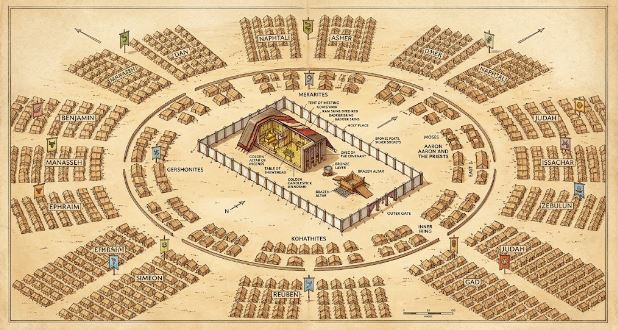
In Numbers 2, the Hebrew Bible details a precise blueprint for how the nation of Israel was instructed to camp during their forty years of wilderness wanderings. At the absolute center sat the Tabernacle (the portable sanctuary containing the Ark of the Covenant), surrounded by an inner ring of priests and Levite clans (Kohath, Gershon, and Merari).
Beyond this inner sanctuary ring, the remaining twelve tribes were stationed in four major three-tribe divisions, positioned precisely at the cardinal directions:
- East: Judah (leading camp), alongside Issachar and Zebulun.
- South: Reuben (leading camp), alongside Simeon and Gad.
- West: Ephraim (leading camp), alongside Manasseh and Benjamin.
- North: Dan (leading camp), alongside Asher and Naphtali.
2. The Four Cardinal Standards and the Cherubim
In Rabbinic tradition (such as the Midrash Numbers Rabbah 2:7) and early biblical commentary, the four leading tribal banners correspond directly to both the four fixed signs of the zodiac and the four faces of the Cherubim seen in the visions of Ezekiel (Ezekiel 1:10) and the Book of Revelation (Revelation 4:7).
Because the four cardinal camps expanded outward in proportion to their populations, an overhead perspective of the camp formed a massive cruciform (cross) layout, anchored by four primary standards at the cardinal points:
- The Eastern Flank (Judah) — Lion / Leo (Fire Element / Lion Face): Positioned at the front (facing the sunrise), Judah was the royal, ruling tribe with a census population of 186,400 men. Jacob directly called Judah a “lion’s cub” in Genesis 49:9.
- The Southern Flank (Reuben) — Man or Water / Aquarius (Air Element / Man Face): Positioned to the south with 151,450 men, Reuben’s banner depicted a man or pouring water, echoing Jacob’s blessing describing him as “unstable as water” (Genesis 49:4).
- The Western Flank (Ephraim) — Ox or Bull / Taurus (Earth Element / Ox Face): Leading the western flank with 108,100 men, Ephraim represented the house of Joseph, described by Moses as having the majesty and strength of a “firstborn bull” (Deuteronomy 33:17).
- The Northern Flank (Dan) — Eagle or Serpent / Scorpio (Water Element / Eagle Face): Guarding the northern flank with 157,600 men, Dan was described by Jacob as a “serpent by the roadside” (Genesis 49:17). In ancient Hebrew astrological symbolism, the negative connotations of the serpent or scorpion were frequently transformed into the soaring Eagle, mirroring the fourth face of the heavenly Cherubim.
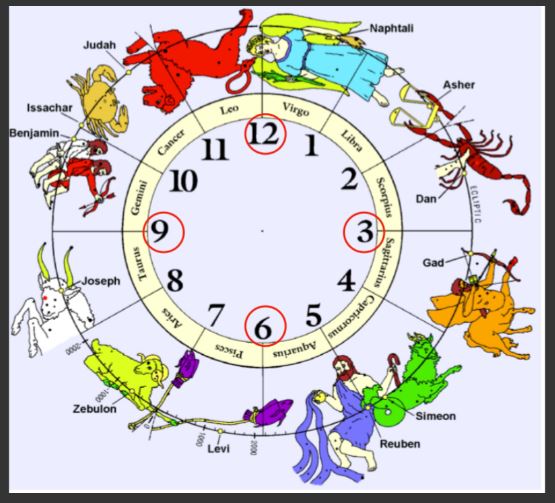
3. Mapping the 12 Tribes to the Zodiac Signs
The remaining eight tribes align with the remaining constellations of the Mazzaroth, primarily derived from the prophetic blessings of Jacob (Genesis 49) and Moses (Deuteronomy 33):
- Judah — Leo (The Lion): The royal banner of leadership and strength.
- Issachar — Cancer (The Crab) or Taurus: Associated with hard labor, agriculture, and bearing burdens (“a strong donkey lying down between two burdens”).
- Zebulun — Gemini (The Twins) or Pisces: Linked to maritime commerce, trade, and havens for ships along the sea coast.
- Reuben — Aquarius (The Water Bearer): Symbolizing water pouring forth and life’s original stream.
- Simeon — Pisces (The Fish): Paired with Levi in early traditions; associated with water, dispersion, and rapid growth.
- Gad — Aries (The Ram): Representing troop leaders, sacrificial valor, and military readiness.
- Ephraim/Manasseh — Taurus (The Bull): Representing agricultural abundance and horn-like power.
- Benjamin — Sagittarius (The Archer): Known as skilled bowmen and military tacticians, described as a ravenous wolf and hunter.
- Dan — Scorpio (The Serpent / Eagle): Representing justice, judgment, and acute sight from above.
- Asher — Libra (The Scales): Associated with rich yield, fair measure, royal dainties, and olive oil.
- Naphtali — Capricorn (The Sea-Goat) or Virgo: Described as a “doe set free” that yields beautiful words, symbolizing swiftness and grace.
- Joseph/Manasseh — Virgo (The Virgin): Associated with fruitfulness, growth, and the “blessings of the breast and womb.”
4. Historical Context: The Zodiac in Ancient Jewish Life
While ancient Jewish law prohibited stargazing for divination or worshiping the planets as deities, tracking the movements of the sun, moon, and constellations was essential for establishing the Hebrew lunar-solar calendar and calculating holy feast days (Passover, Sukkot, Yom Kippur).
By late antiquity (3rd–6th century CE), Jewish communities routinely incorporated the 12 signs of the zodiac into sacred architecture. Prominent archaeological discoveries across Israel—including the ancient synagogue floor mosaics at Beth Alpha, Hammat Tiberias, and Sepphoris—feature the full Mazzaroth wheel labeled in Hebrew script.
To these ancient communities, the zodiac wheel was not a tool of fatalism, but a visual expression of God’s sovereign design—a cosmic clock declaring that the same God who ordered the stars in the heavens had set the twelve tribes of Israel in their earthly places